

Entering the Eyal Ofer Galleries at Tate Modern this spring and discovering My Bed once more, nearly thirty years older, with the sheets still rumpled, the vodka bottles still half-tipped, and the slippers still kicked aside as if their owner had just gone outside for a cigarette, has a subtly defiant quality. Now, the crowd surrounding it appears different. Younger people use their phones to lean in. Elderly guests stand back, folding their arms, trying to figure something out. Seeing a piece of art that once sparked a cultural conflict treated like a relic deserving of preservation is an odd sensation.
Tracey Emin is sixty-two. She has survived cancer, no bladder, and chronic pain, all of which she discusses with the candor of someone who has given up pretending. However, the career-spanning exhibition A Second Life, which debuted at Tate Modern in late February, doesn’t feel like a triumph. Compared to that, it feels more uncertain. More unprocessed. Even now, it seems as though Emin is still unsure of how she became canonized—Dame, Royal Academician, the establishment’s favorite enfant terrible—given that so much of her work relied on her refusal to act appropriately.
| Field | Details |
|---|---|
| Full Name | Dame Tracey Karima Emin DBE RA |
| Date of Birth | 3 July 1963 |
| Place of Birth | Croydon, London, England |
| Raised In | Margate, Kent |
| Nationality | British (Romanichal English mother, Turkish Cypriot father) |
| Education | Medway College of Design; Maidstone College of Art (BA, Printmaking); Royal College of Art (MA, Painting) |
| Known For | My Bed (1998), Everyone I Have Ever Slept With 1963–1995 (1995) |
| Movement | Young British Artists |
| Media | Painting, neon text, sewn appliqué, sculpture, film, drawing |
| Major Honours | Royal Academician (2016); Damehood (DBE) |
| Current Exhibition | A Second Life, Tate Modern (27 Feb – 31 Aug 2026) |
| Studio / Foundation | TKE Studios, Margate |
| Represented By | White Cube, Xavier Hufkens, Lehmann Maupin |
Although it’s the obvious anchor, the bed isn’t the room’s most intriguing feature. These are the more recent paintings. After her illness, she painted large, blood-colored, bruised canvases of women collapsing into themselves. Compared to the well-known installations, they are more difficult to look at. Not as ironic. They don’t contain any humor, Britpop swagger, or tabloid bait. Just paint applied by someone who sincerely believed she might not live to see it through to completion.
It’s difficult to ignore how the discourse surrounding Emin has changed. The Daily Mail dubbed My Bed the “stomach Turner” when it was shortlisted for the Turner in 1999, and strangely, The Guardian joined in the tutting. Craft was rarely the subject of the complaint. It was about a woman revealing the details of her life without organizing them into something palatable, such as the period pants, the stained sheets, and the contraceptives. Back then, critics seemed to favor neat art created by women. For years, Emin’s refusal cost her column inches.
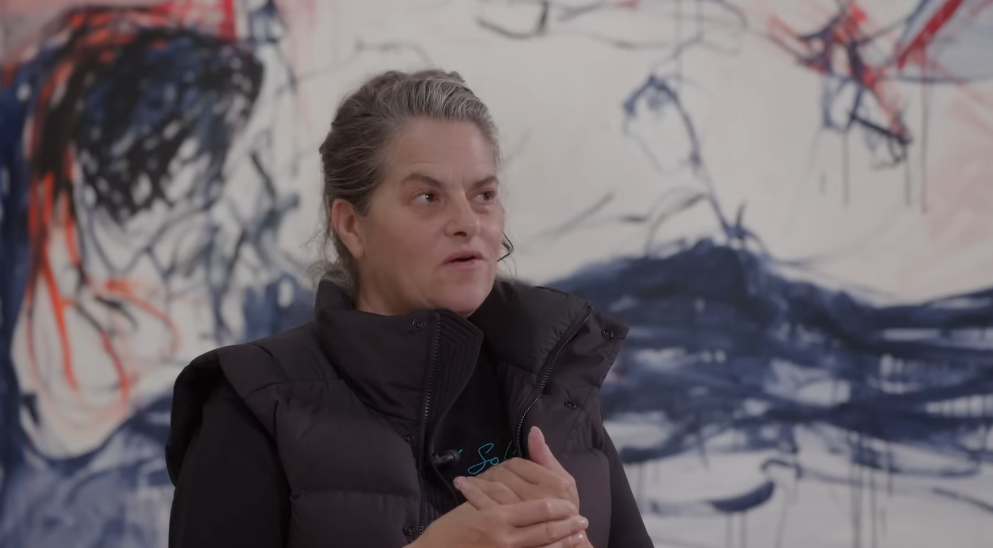
These days, respectful profiles appear in the same newspapers. In February, the BBC published a lengthy article referring to the bed as an icon. The Tate show received four stars from The Times. Gucci has a partnership. The most telling aspect of all of this seems to be Emin’s return to the town that shaped her and her quiet construction of infrastructure for the next generation at the TKE Studios, a foundation in Margate where she funds workspace for younger artists.
It remains to be seen if the establishment has truly comprehended her or if it has just endured its own unease. There has been no softening of the work. If anything, the new paintings are more aggressive than the bed ever was. They simply don’t have the cacophony of youth and inebriation on TV. Perhaps that’s what altered. Not Emin. the viewers.
You get the impression that A Second Life is the appropriate title for more reasons than just the obvious ones as you watch this develop. It goes beyond simply overcoming cancer. It tells the story of an artist who, despite being told at every turn what kind of woman she should be—the wild one, the embarrassed one, the recovering one, the dignified one—continues to paint. The bed remains in place. She is, too. It’s finally quiet enough to look around the room.
