

Something about this is almost too good to be true. The most copied academic item on Instagram right now is about the German philosopher Walter Benjamin. Benjamin spent most of his career thinking about what happens when art is copied and shared over and over again. The card with his picture on it is everywhere. On tables for seminars. Right next to the coffee cups. placed on top of stacks of old paperbacks. Taken pictures, edited, posted, and re-posted.
It’s hard not to see the irony in this situation.
During his lifetime, Benjamin’s name never quite became as well known as Freud’s or Marx’s. In desperate and tragic circumstances, he died in 1940 in Portbou, which is on the border between France and Spain. He was carrying one of his most valuable possessions, a small painting by Paul Klee called Angelus Novus. It was said that he bought it in 1921 and never gave it up. It’s interesting to think about Benjamin, who wrote so carefully about things and what they meant, running away from the Nazis while holding a work of art. That image alone shows how much weight he gave to things, to their presence, to what he called their “aura.”
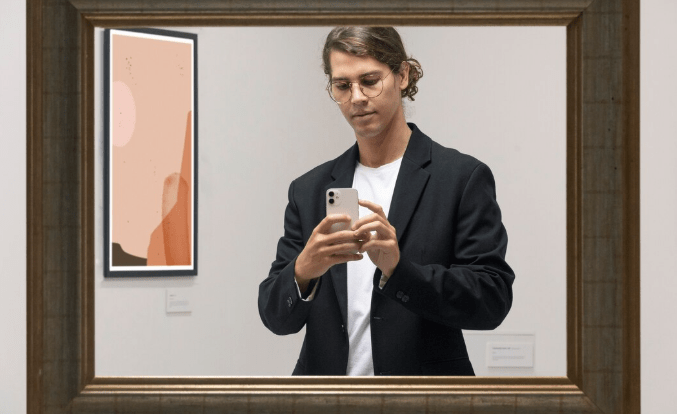
His picture is now on a card. That card is being photographed by graduate students, cultural critics, museum visitors, and regular people who read English all over the world. It’s an odd kind of afterlife, but Benjamin probably wouldn’t have ruled it out completely.
The timing isn’t just a coincidence. This spring, the Jewish Museum in New York opened a focused exhibition called Walter Benjamin and the Edges of Photography. It will run until early August 2026. It comes from the Israel Museum in Jerusalem and has photos by Karl Blossfeldt, László Moholy-Nagy, Man Ray, and August Sander, all of whom Benjamin wrote about. Along with that, it has the only print of Germaine Krull’s famous portrait of Benjamin from 1927, which has rarely been seen in public in the US before. As you walk by, you get the sense that the exhibition itself was always going to get this much attention on social media—not because the curators planned it, but because the subject matter practically begs for it.
Benjamin’s main point in his 1936 essay The Work of Art in the Age of Mechanical Reproduction was that photography and mass reproduction take away the “aura” of the original artwork, which is its uniqueness and connection to a certain time and place, while also making art available to everyone. He wasn’t just happy about this; he had mixed feelings about it. More people are affected by the reproduction. The copy does lose something, though. It’s still not clear whether he thought that loss was tragic or just a new situation to deal with honestly.
What he probably didn’t think of was Instagram. He might have done better, though. For years, scholars like Michael Sankey have been wondering what Benjamin would have thought of digital reproduction—of a world where pictures are copied in milliseconds instead of print runs and used on phones instead of posters. The question doesn’t seem as important as it did five years ago.
The small card with a serious message on it has become a kind of cultural shorthand. It tells you something about the person who has it: they read, they think, and they pay attention to ideas that don’t go out of style very often. A small amount of performance is present, as is always the case with this type of object. There is, however, something real going on. People are reading Benjamin’s works again. The reviews of the exhibitions have been well-thought-out. Sometimes the conversations that happen under the posts get real.
He wrote that history is not a straight line of progress. He thought it was messier, with more damage and mistakes happening over and over. It’s probably not clear whether putting a philosopher’s face on a card that a lot of people share is progress or just more noise. But the fact that his ideas are being spread again through the very thing he would have found most interesting to study is something that deserves attention.
